Being near drugs is not the same as possessing them, but that difference rarely stops an arrest. When officers find something in a shared car, a roommate's room, or a bag that passed through several hands, everyone nearby often goes to jail and the questions come later. Sloane Law Firm defends constructive possession cases in Texas by pressing the two questions that decide them: can the State prove the drugs were yours, and was the search that found them legal?
If you were charged over drugs you did not know about, call (817) 810-0088. We practice only criminal defense, and these two defenses are at the center of how we handle drug cases.
Your future is at stake—do not hesitate to contact the Sloane & Routledge Law Firm
What Is Constructive Possession Under Texas Law?
Constructive possession is the State's theory when drugs were not found on your body but prosecutors claim you controlled them anyway. Texas defines possession as actual care, custody, control, or management, and the State must also prove you knew the substance was contraband.

Actual Possession
Actual possession covers drugs in your hand, your pocket, or your waistband. Those cases usually turn on knowledge and on whether the search was legal.
Constructive Possession
Constructive possession covers everything else: a console, a closet, a kitchen drawer, a backpack on the floor. The Texas Court of Criminal Appeals has made clear that simply being present where drugs turn up does not prove possession by itself, and your connection to the drugs has to be more than a coincidence.
Can I Be Charged if the Drugs Weren't Mine?
You may be charged for drugs that were not yours, but a charge is not a conviction. When you did not have sole control over the place where drugs were found, Texas requires additional facts linking you to the drugs. Without those links, the evidence is legally insufficient.
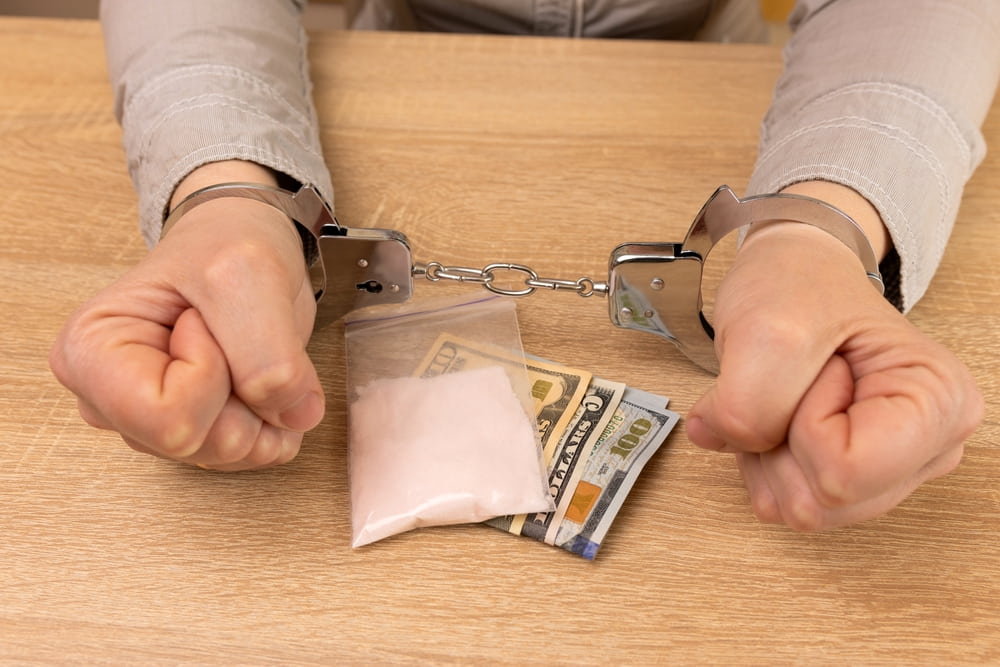
That rule protects people who happen to be in the wrong place at the wrong time. It comes up most often in situations like these:
- A traffic stop with several people in the car and drugs in the glove box or under a seat
- A borrowed or rental vehicle
- An apartment search where drugs turn up in a common area
- A hotel room registered to someone else
Officers often arrest everyone present and leave it to prosecutors to sort out who owned what. Sorting it out is where the defense does its most important work.
What Links Do Texas Courts Use to Tie a Person to Drugs?
Texas courts use a set of factors, often called affirmative links, to decide whether the evidence connects a person to drugs found nearby. No single factor is required, and the number of factors matters less than how strongly the facts, taken together, point to knowing possession. Courts commonly consider:
- Whether you were present when the search happened
- Whether the drugs were in plain view
- How close you were to the drugs and whether you could reach them
- Whether you appeared to be under the influence when arrested
- Whether you had other drugs or paraphernalia on you
- Whether you made incriminating statements
- Whether you tried to run
- Whether you made furtive gestures
- Whether there was an odor of drugs
- Whether other contraband or paraphernalia was present
- Whether you owned or had the right to control the place where the drugs were found
- Whether that place was enclosed
- Whether you were carrying a large amount of cash
- Whether your conduct showed a consciousness of guilt
How the Links Shape a Constructive Possession Defense
We compare every factor against the body-camera footage and the offense report. A passenger who sat away from the drugs, said nothing incriminating, and had nothing on him may have very few links at all. The State's case rests on whatever links remain, and weak links make for a weak case.
How Do Prosecutors Argue Drugs in a Shared Space Belonged to You?
Prosecutors usually build a shared-space case on three facts: where you were, what you said, and what else officers found. The argument shifts depending on the setting.

In a Shared Car
The State often claims the driver controls everything inside and a passenger controls whatever was within reach. That argument weakens when the car was borrowed, rented, or regularly driven by other people.
In a Shared Home or Apartment
Prosecutors look for your belongings near the drugs, mail with your name on it, or a room that is clearly yours. Drugs in a common area like a kitchen or living room are much harder to pin on one resident.
In a Bag or Jacket
The question is who owned the item and who packed it. A backpack several people used, or a jacket borrowed for the night, does not prove knowledge on its own.
Every link the State claims deserves a second look. Call (817) 810-0088 so we can start with the video and the report.
When Is a Police Drug Search Illegal in Texas?
A police search is illegal when officers act without a warrant and without a recognized exception, or when they go further than the law allows. Evidence obtained in violation of the state or federal constitution, or state or federal law, may not be used against you at trial under Article 38.23 of the Texas Code of Criminal Procedure.

Traffic Stops That Last Too Long
A traffic stop may last only as long as it takes to handle the reason for the stop, such as writing a ticket and checking a license. Once that work is done, officers need reasonable suspicion of another crime to keep you there.
When a Dog Sniff Leads to a Possession Charge
A dog sniff during a lawful stop is generally allowed. In Rodriguez v. United States, the U.S. Supreme Court held that officers may not extend a stop to run a dog sniff without reasonable suspicion. Dispatch logs and body-camera timestamps usually show whether that line was crossed.
Consent That Was Not Really Voluntary
Consent has to be freely given, and you may limit it or take it back. A request to search after an officer has kept your license and ordered you out of the car raises real questions about whether you felt free to say no.
Odor and Plain View
Officers may seize what they plainly see from a place they are lawfully allowed to be. Odor is a common reason given for searching a car, but legal hemp and marijuana smell the same, and we challenge searches that rest on smell alone.
The Automobile Exception
Officers may search a vehicle without a warrant when they have probable cause to believe it holds contraband. That probable cause has to exist before the search begins. Finding drugs afterward does not justify the search after the fact.
Entering a Home Without a Warrant
A home receives the strongest protection the law offers. Without a warrant, officers generally need valid consent, an emergency, or hot pursuit. A roommate usually cannot consent to a search of your locked bedroom, and a landlord generally cannot consent to a search of your apartment.
What Does a Motion to Suppress Do in a Drug Case?
A motion to suppress asks the judge to throw out evidence that officers obtained illegally. When a court grants the motion, the drugs, any statements, and anything else found because of the bad search are kept away from the jury. In many possession cases, the State is left with nothing to try.

The process usually unfolds in four steps:
- We file the motion and ask the court to set a hearing before trial.
- Once we show the search happened without a warrant, the State takes on the burden of justifying it.
- The officer testifies and is questioned against the video, the dispatch records, and the written report.
- The judge rules, and a granted motion often leads to dismissal.
Even a denied motion has value. The hearing locks the officer's account into the record and often shapes the plea discussions that follow.
How Do Search and Possession Defenses Work Together?
Search and possession defenses cover the two ways a drug case ends early: the evidence never reaches the jury, or it reaches the jury but never connects to you. We look at both from the first day, because the same facts often matter to each.
- If the search fails, the possession question may never come up.
- If the search holds, the affirmative links decide whether the State is able to prove possession at all.
- If prosecutors have added an intent to deliver allegation, both defenses still apply, with intent as one more element to challenge.
What Should I Do After Being Charged Over Drugs in a Shared Space?
Protecting a shared-space defense starts with what you say and what you save. Anything you tell officers or investigators about who owned the drugs, who else used the car, or who stayed in the room may become one of the links the State needs.

- Write down everything you remember about the stop or the search while it is fresh, including who was present, where each person was sitting or standing, what officers asked, and how long you waited.
- Hold on to rental agreements, leases, or anything else showing who had access to the car or the home.
- Avoid discussing the case by phone or text, especially with the other people who were there, since those conversations may end up in the State's file.
- Let us request the video and dispatch records before they become harder to obtain.
Why Choose Sloane Law Firm for a Search or Possession Defense?
- Suppression work is central to our practice. We handle criminal defense only, and challenging stops and searches is part of nearly every drug case we take.
- We go straight to the timeline. Body-camera video, dispatch logs, and CAD records are among the first things we request, because minutes and seconds often decide these motions.
- We are close to the courthouse. Our office at 933 W Weatherford St sits near the Tarrant County courts where these hearings take place.
Questions About Drug Searches and Shared-Space Charges
What happens if drugs are found in someone else's car in Texas?
Riding in a car where drugs are found does not make you guilty of possession. The State must show you knew the drugs were there and exercised control over them. Where you sat, whether the drugs were visible, what you said, and what was on your person are usually the facts that decide the case.
Can police search my car during a traffic stop in Texas?
Police need a warrant, valid consent, probable cause, or another recognized exception to search your car during a traffic stop. A traffic violation alone does not authorize a search. If officers stretched out the stop to get consent or to wait for a drug dog, the search and everything it produced may be challenged.
Does refusing a search make me look guilty?
Refusing a warrantless search is a constitutional right, and a refusal is not evidence of guilt. Saying no clearly and calmly does not stop officers who believe they have another legal basis, but it preserves your ability to challenge that search in court later. Never physically resist, even if you believe the search is wrong.
Being There Is Not Proof. Neither Is a Bad Search.
If the drugs were not yours, or the search should never have happened, the State has a problem worth finding early. Call us if any of these describe your arrest:
- Drugs were found in a car you did not own or were only riding in
- Drugs turned up in a shared home, room, or common area
- The drugs were in a bag or jacket that belonged to someone else
- The stop dragged on, a dog was brought in, or officers searched after you said no
Call Sloane Law Firm at (817) 810-0088 to talk with a Fort Worth drug defense attorney. Our office is open Monday through Friday, 8:00 AM to 4:00 PM. Protecting the Dallas - Fort Worth Metroplex.